

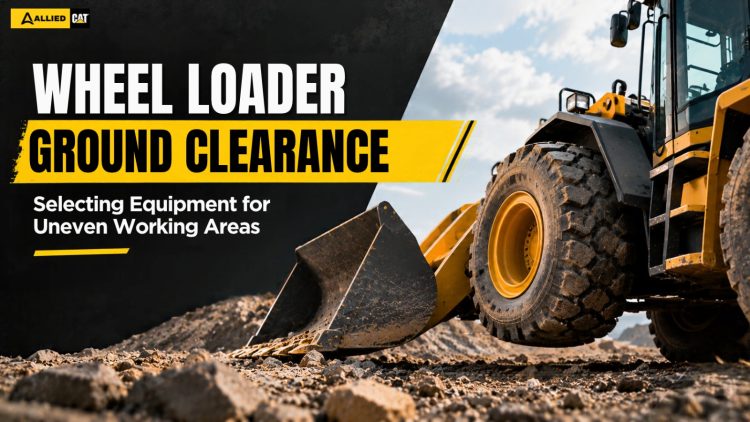
Wheel loaders handle, load, and move materials across different working environments. However, not every site has a smooth and level surface. Construction areas, material yards, and uneven ground can challenge equipment movement. In these conditions, wheel loader ground clearance is an important factor to consider when selecting a suitable machine.
Understanding ground clearance helps businesses choose equipment that matches site conditions and daily operating requirements.
What Is Wheel Loader Ground Clearance?
Ground clearance refers to the distance between the ground and the lowest part of a machine’s underbody. It helps determine how much space is available beneath the machine when travelling over uneven surfaces.
A wheel loader with suitable ground clearance can move across certain surface irregularities with a lower risk of the underbody contacting the ground. However, ground clearance alone does not determine a machine’s ability to work on difficult terrain. Tire selection, machine dimensions, traction, and ground conditions also affect its performance.
Why Ground Clearance Matters on Uneven Working Areas
Uneven surfaces may include loose soil, gravel, rough ground, and areas with small raised sections. When selecting a wheel loader for these environments, ground clearance should be considered alongside other machine specifications.
Reducing Underbody Contact
Rocks, raised ground, and uneven surfaces can come into contact with the underside of a machine. Appropriate ground clearance provides additional space between the underbody and the working surface, depending on the terrain and machine configuration.
Supporting Movement Across Rough Surfaces
Wheel loaders may need to travel between material piles, loading points, and unloading areas. Suitable ground clearance can help the machine move across surface irregularities without unnecessary underbody interference.
Matching Equipment to Site Conditions
Different sites have different surface conditions. A loader operating in a prepared material yard may have different requirements from one working on rough construction ground. Considering ground clearance during equipment selection helps businesses assess whether a machine is suitable for its intended environment.
Factors to Consider When Selecting a Wheel Loader
Ground clearance should not be the only specification considered when choosing a wheel loader. Other factors also influence machine suitability.
- Tire type and size: Tires affect traction, ground contact, and the machine’s ability to move across different surfaces.
- Machine dimensions: Overall height, width, wheelbase, and approach angles can affect movement through restricted or uneven areas.
- Operating conditions: The type of material, ground slope, surface firmness, and presence of obstacles should be assessed before selecting equipment.
- Bucket capacity: The bucket should match the material handling requirements and the machine’s operating limits.
- Manufacturer specifications: Checking the machine’s technical details helps confirm its ground clearance and suitability for the intended application.
How to Assess Ground Clearance Requirements
Before choosing a wheel loader, inspect the working area and identify the main challenges the machine may encounter. Look for raised surfaces, uneven tracks, loose materials, and obstacles that could interfere with the underbody.
Next, compare these conditions with the manufacturer’s ground clearance specifications and other relevant dimensions. Consider the machine’s loaded and unloaded operating conditions, as well as the type of work it will perform.
It is also important to assess traction, stability, and safe operating limits. Ground clearance does not automatically make a wheel loader suitable for steep slopes, soft soil, or highly irregular terrain. The complete machine configuration must match the job requirements.
Frequently Asked Questions
1. What is ground clearance in a wheel loader?
Ground clearance is the distance between the ground and the lowest part of the machine’s underbody. It helps indicate how much space is available when travelling over uneven surfaces.
2. Why is ground clearance important for construction sites?
Construction sites may have rough surfaces, loose materials, and raised sections. Suitable ground clearance can help reduce the risk of the machine’s underbody contacting these irregularities.
3. Does higher ground clearance always mean better performance?
No. Ground clearance is only one factor in machine selection. Traction, stability, tire configuration, machine dimensions, and operating conditions also affect performance.
4. How can I choose the right wheel loader for uneven ground?
Assess the site conditions, compare manufacturer specifications, and consider ground clearance, tire configuration, machine dimensions, and bucket requirements before selecting a model.
5. Can ground clearance affect wheel loader safety?
Yes. Appropriate ground clearance can help reduce underbody contact with surface obstacles. However, safe operation also depends on proper loading, suitable terrain, operator training, and following the manufacturer’s instructions.
Conclusion
Wheel loader ground clearance is an important consideration when selecting equipment for uneven working areas. It helps businesses assess the space available beneath a machine and the potential for underbody contact with surface obstacles. By evaluating ground conditions alongside tire configuration, machine dimensions, traction, and manufacturer specifications, businesses can select a wheel loader that better matches their operational needs. Careful equipment selection supports more suitable machine movement and efficient material handling across different working environments.

