

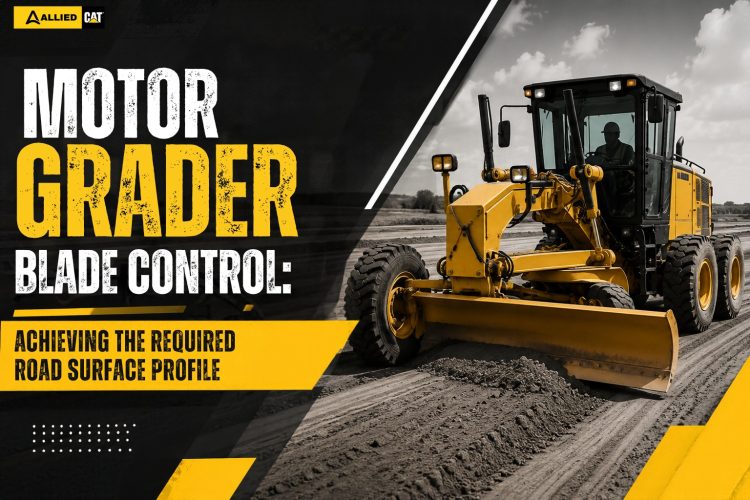
Road construction requires accurate grading to create smooth, properly shaped surfaces. Motor graders play an important role in this process by cutting, spreading, and levelling materials to achieve the required road profile. The machine’s blade control is particularly important because even small adjustments can affect the finished surface.
For construction teams, understanding motor grader blade control helps in selecting suitable equipment and planning roadwork according to project requirements.
Understanding Motor Grader Blade Control
A motor grader is a heavy construction machine equipped with a long, adjustable blade positioned between its front and rear wheels. This blade allows operators to move and level materials across the working surface.
Caterpillar motor graders are designed for grading and road construction applications. Their adjustable blade systems allow operators to control blade position and cutting angle according to the work being performed.
Proper blade adjustment helps distribute material evenly and maintain the required surface shape. This is important when preparing road bases, levelling construction areas, and carrying out finishing work.
How Blade Position Affects Road Surface Quality
The position and angle of a motor grader blade influence how material is cut, moved, and spread. Operators must consider several factors when adjusting the blade for a particular task.
- Blade angle: The angle affects how material moves along the blade during grading.
- Cutting depth: Appropriate blade depth helps remove or redistribute the required amount of material.
- Blade tilt: Adjusting the blade tilt can help accommodate different grading conditions.
- Machine movement: Consistent machine movement helps maintain an even finish across the working area.
The Role of Motor Graders in Road Construction
Motor graders are used during different stages of road preparation, from shaping the ground to finishing prepared surfaces. Their adjustable blades allow operators to work with loose soil, aggregates, and other suitable grading materials.
During road base preparation, a motor grader helps spread material evenly before subsequent construction activities. During finishing operations, accurate blade positioning helps create the required surface shape and level.
Choosing suitable motor grader equipment for road construction depends on the project’s scale, working conditions, and grading requirements. Contractors should review machine specifications and operating capabilities before selecting equipment.
Choosing the Right Caterpillar Motor Grader
Selecting a motor grader involves more than considering the machine’s size. Contractors should evaluate the type of grading work, required surface profile, site accessibility, and expected workload.
When considering a Caterpillar motor grader, important factors include blade dimensions, machine capabilities, operating requirements, and compatibility with the intended application.
For projects involving road formation, site preparation, or surface levelling, choosing machinery that matches the required grading work helps support an organized construction process.
Allied Engineering and Services Limited (AESL) provides Caterpillar equipment solutions for construction and industrial applications. Businesses can consult AESL to explore available machinery and identify equipment suited to their project requirements.
Frequently Asked Questions
1. What is motor grader blade control?
Motor grader blade control involves adjusting the blade’s position, angle, tilt, and cutting depth to move material and achieve the required surface profile.
2. What are Caterpillar motor graders used for?
Caterpillar motor graders are used for road construction, surface levelling, road base preparation, and other grading applications.
3. Why is blade angle important in road grading?
Blade angle affects how material moves along the blade and influences the machine’s ability to spread and shape material across a surface.
4. How do I choose the right motor grader?
Consider the grading task, required surface profile, site conditions, machine specifications, and project workload.
Conclusion
Motor grader blade control is an important part of achieving the required road surface profile. Correct blade positioning, cutting depth, and angle help operators manage material and perform grading tasks according to project specifications. By selecting suitable Caterpillar motor graders and considering the demands of each site, contractors can plan road construction and surface preparation more effectively. AESL can help businesses explore Caterpillar equipment solutions for their construction requirements.

